AI Design
Pairfect Design Studio
Pairfect Design Studio

Edison Sathiyaseelan
Content Head & UX UI Designer
Dec 9, 2025
From Prompts to Products: The Rise of AI-Generated Design Workflows
From Prompts to Products: The Rise of AI-Generated Design Workflows
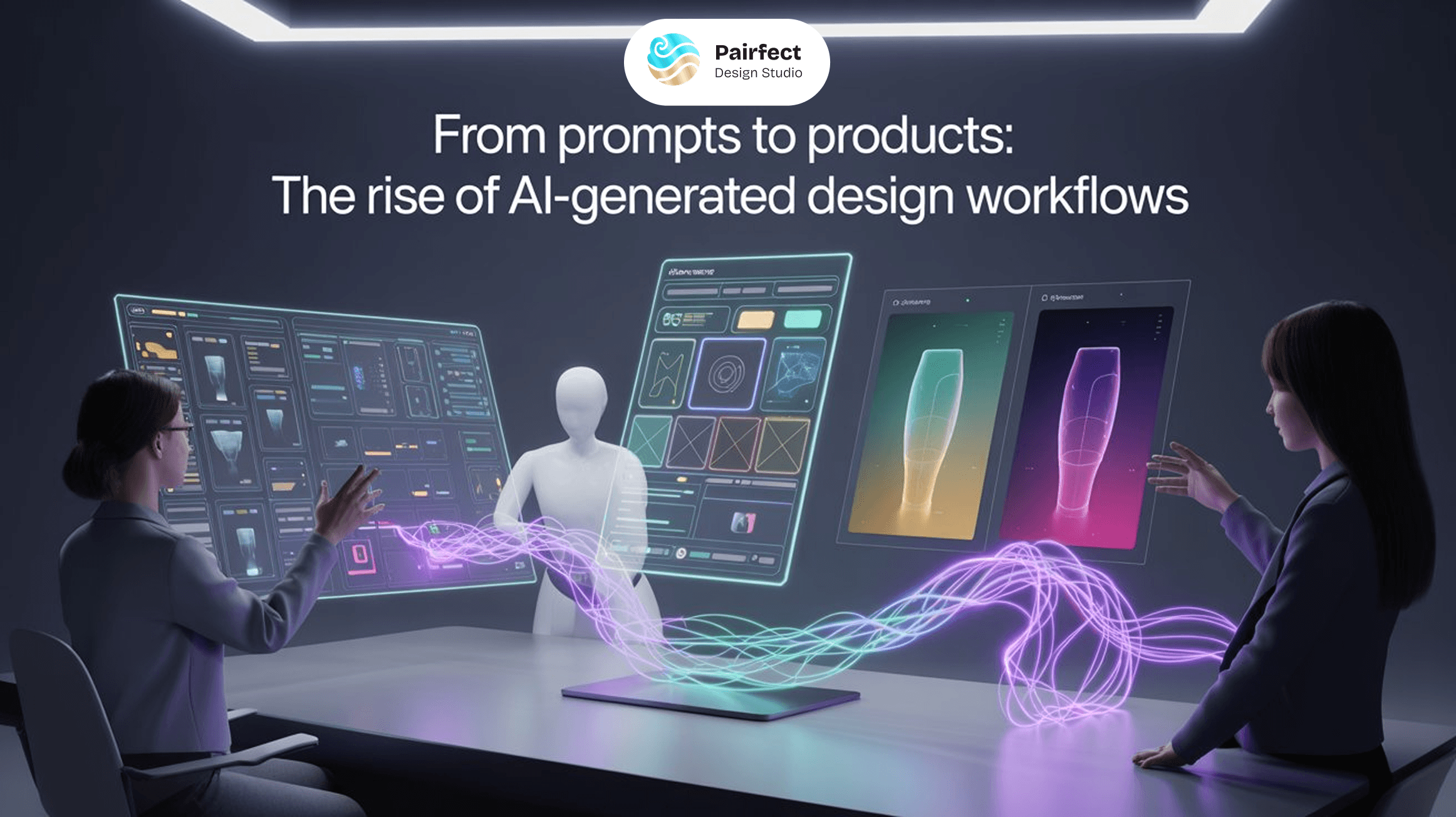
AI-generated design workflows turn simple prompts into fast, high-quality design outputs.
Within a few years, the evolution of the design sector has taken one of the fastest and most profound transformations in its history. What once took weeks of brainstorming, sketching, prototyping, and manual iteration now begins with just one prompt. Creative teams across the globe are leveraging AI ML learning, using new workflows to use artificial intelligence as part of their daily design pipelines. Instead of relying on traditional processes, designers now combine human intuition with ai ml technology to generate design outputs, turning ideas into reality faster than ever.
This shift isn’t about replacing designers. It’s about elevating them. Today’s designers act as strategists and curators, guiding ai design course models and shaping intelligent systems. They lead workflows that merge creativity and computation, allowing teams to innovate in ways that were previously unimaginable.
This blog explores the transition from handcrafted workflows to prompt-driven design, why ux design ai tools are becoming the norm, and how businesses can take advantage of this shift to produce smarter, faster, and more scalable creative work.
1. The Breaking Point: Why Traditional Design Needed Evolution
Design has always been a balancing act, but the digital era increased complexity at an exponential rate. Multiple device sizes, fast-moving trends, increased competition, and the demand for scalable brand systems created bottlenecks everywhere.
Many teams were slowed down because designers manually handled everything. Iterations were limited, and teams spent too much time recreating assets, testing concepts, or generating prototypes. Learning with AI and using learning algorithms became a natural next step for scaling creativity.
AI arrived exactly when the industry needed it. With ai ml models, designers can now automate tasks, explore variations instantly, and test ideas faster. Instead of laboring over repetitive work, they can focus on refining strategy, storytelling, and brand emotion.
2. Prompts: The New Creative Language
Prompts have become the new foundation of creativity. A prompt is simply a clear set of instructions from layout direction to emotional tone fed into an AI model.
Through prompts, designers generate:
Branding systems
App UI screens
Product mockups
Color palettes
Layout explorations
3D immersive UI design
AI tools now produce hundreds of variations instantly, allowing designers to jump straight into curation and refinement. The better the prompt, the stronger the result. This is where designers apply their mastery of ui design ai, ai user interface design, and ai for ui design.
Prompts don’t limit creativity. They expand it.
3. AI as Co-Developer: From Research to Execution
AI today isn’t just a generator, it's a creative partner. With machine learning and artificial intelligence, teams can now explore more concepts, refine direction based on constraints, and eliminate repetitive tasks such as background cleanup or image resizing.
Some tools even convert generated prototypes into usable front-end code. This blend of ai ui design, ai ux design, and ai and design allows teams to visualize, validate, and ship ideas far faster.
4. The AI-Modeled Design Process
A fully developed AI-supported workflow often looks like this:
1. Intent (Prompt Phase)
The designer interprets goals, translating them into a structured prompt. This is where knowledge of intro to ai and machine learning and ai modeling becomes valuable.
2. Examine & Select (Vision Phase)
AI generates multiple variations. Designers select the strongest options based on brand objectives.
3. Refine & Modify (Iteration Phase)
Designers guide adjustments color, spacing, typography using clarity and human intuition.
This phase mirrors machine learning process styles: tweak → observe → improve.
4. Build & Prototype (Production Phase)
Tools like Figma AI, Webflow AI, and Framer AI allow teams to develop real UI and interaction flows.
Here, create a ui with ai, ai interface, and ai interface design shine.
5. Validate & Test (User Insight Phase)
AI assists in usability predictions, friction analysis, and accessibility checks. Designers use ai for ux, ux ai, and ai and ux design to ensure user-first thinking.
6. Deliver & Handoff
AI exports final assets with perfect consistency. The workflow unites design systems with ai learning models and allows rapid scaling.
5. The Rise of AI in Branding
Branding is undergoing an AI revolution. Designers now rely on artificial intelligence design and ai for design to generate:
Logos
Font pairings
Moodboards
Mockups
Motion graphics
Full identity systems
AI generates. Designers curate. This evolution empowers brands to experiment more, explore variations, and scale faster.
6. AI Begins the Next Chapter of UI/UX
AI is transforming user experience design and ui design from the ground up. Teams use it for:
Accessibility
Component creation
Layout generation
Design system scaling
Micro-interaction creation
AI-integrated motion design
Hyper-personalized UX with AI
With ai ui, ui ux ai, and ai ux, designers automate repetitive tasks so they can spend more time enhancing user flows, emotional storytelling, and interaction logic.
7. AI Produces Designers Decide
A common misconception is that AI will replace designers. It will not.
Design requires:
Empathy
Strategy
Psychology
Culture
Ethics
Storytelling
AI cannot understand nuance without guidance. It cannot interpret emotional context or make ethical judgments. It cannot replace a designer’s intuition or strategic thinking.
Designers remain orchestrators of creativity, directing AI machine learning and ai modeling to bring visions to life.
8. Why Companies Are Adopting AI Workflows
Companies of all sizes from startups to enterprises are embracing machine learning applications and ai uses because they produce measurable advantages:
Faster design cycles
Reduced costs
Higher output
Stronger consistency
Increased testing possibilities
Future-ready teams
AI amplifies capabilities not costs.
9. Designers Are Evolving Into Orchestrators
Designers are becoming:
Prompt engineers
Creative directors
Experience strategists
Design system architects
AI workflow experts
This shift frees designers from repetitive production so they can focus on big ideas and high-level direction. Knowledge of learning ai and machine learning, machine learning methods, and basics of ai and machine learning will become essential.
10. The Future: Fully Integrated AI Creativity Pipelines
We’re heading toward a world where:
Sites generate themselves from brand prompts
Apps adapt UI layouts using adaptive ai
Products learn user behavior in real time
Content and design merge through automation
Machine learning deep learning models refine interfaces continuously
Design is shifting from static creation to dynamic evolution powered by ai and machine learning, ai ml, and ml ai.
Final Thoughts
The transition from traditional workflows to AI-powered design pipelines marks one of the most important shifts in design history. Designers aren’t becoming obsolete, they are becoming more empowered, more strategic, and more creative. AI accelerates ideas, expands possibilities, and transforms how we build digital experiences, ui user interface design, and ux experience.
At Pairfect Design Studio, we embrace this evolution by using AI not as a shortcut but as a creative amplifier. Our mission is to use ai ml learning, machine learning, and intelligent workflows to deliver faster, smarter, and more impactful design solutions for clients across the globe.

Tell Us What to Build
Share what you want to launch. product, website, or MVP, and we’ll respond with the right low‑code approach, estimate, and roadmap to go live.
Let’s Connect & Create Something Beautiful!
Reach out to us today and let’s discuss your needs.
Let’s Connect & Create Something Beautiful!
Reach out to us today and let’s discuss your needs.
Let’s Connect & Create Something Beautiful!
Reach out to us today and let’s discuss your needs.
AI-generated design workflows turn simple prompts into fast, high-quality design outputs.
Edison Sathiyaseelan
Content Head & UX UI Designer
Dec 9, 2025
From Prompts to Products: The Rise of AI-Generated Design Workflows
Within a few years, the evolution of the design sector has taken one of the fastest and most profound transformations in its history. What once took weeks of brainstorming, sketching, prototyping, and manual iteration now begins with just one prompt. Creative teams across the globe are leveraging AI ML learning, using new workflows to use artificial intelligence as part of their daily design pipelines. Instead of relying on traditional processes, designers now combine human intuition with ai ml technology to generate design outputs, turning ideas into reality faster than ever.
This shift isn’t about replacing designers. It’s about elevating them. Today’s designers act as strategists and curators, guiding ai design course models and shaping intelligent systems. They lead workflows that merge creativity and computation, allowing teams to innovate in ways that were previously unimaginable.
This blog explores the transition from handcrafted workflows to prompt-driven design, why ux design ai tools are becoming the norm, and how businesses can take advantage of this shift to produce smarter, faster, and more scalable creative work.
1. The Breaking Point: Why Traditional Design Needed Evolution
Design has always been a balancing act, but the digital era increased complexity at an exponential rate. Multiple device sizes, fast-moving trends, increased competition, and the demand for scalable brand systems created bottlenecks everywhere.
Many teams were slowed down because designers manually handled everything. Iterations were limited, and teams spent too much time recreating assets, testing concepts, or generating prototypes. Learning with AI and using learning algorithms became a natural next step for scaling creativity.
AI arrived exactly when the industry needed it. With ai ml models, designers can now automate tasks, explore variations instantly, and test ideas faster. Instead of laboring over repetitive work, they can focus on refining strategy, storytelling, and brand emotion.
2. Prompts: The New Creative Language
Prompts have become the new foundation of creativity. A prompt is simply a clear set of instructions from layout direction to emotional tone fed into an AI model.
Through prompts, designers generate:
Branding systems
App UI screens
Product mockups
Color palettes
Layout explorations
3D immersive UI design
AI tools now produce hundreds of variations instantly, allowing designers to jump straight into curation and refinement. The better the prompt, the stronger the result. This is where designers apply their mastery of ui design ai, ai user interface design, and ai for ui design.
Prompts don’t limit creativity. They expand it.
3. AI as Co-Developer: From Research to Execution
AI today isn’t just a generator, it's a creative partner. With machine learning and artificial intelligence, teams can now explore more concepts, refine direction based on constraints, and eliminate repetitive tasks such as background cleanup or image resizing.
Some tools even convert generated prototypes into usable front-end code. This blend of ai ui design, ai ux design, and ai and design allows teams to visualize, validate, and ship ideas far faster.
4. The AI-Modeled Design Process
A fully developed AI-supported workflow often looks like this:
1. Intent (Prompt Phase)
The designer interprets goals, translating them into a structured prompt. This is where knowledge of intro to ai and machine learning and ai modeling becomes valuable.
2. Examine & Select (Vision Phase)
AI generates multiple variations. Designers select the strongest options based on brand objectives.
3. Refine & Modify (Iteration Phase)
Designers guide adjustments color, spacing, typography using clarity and human intuition.
This phase mirrors machine learning process styles: tweak → observe → improve.
4. Build & Prototype (Production Phase)
Tools like Figma AI, Webflow AI, and Framer AI allow teams to develop real UI and interaction flows.
Here, create a ui with ai, ai interface, and ai interface design shine.
5. Validate & Test (User Insight Phase)
AI assists in usability predictions, friction analysis, and accessibility checks. Designers use ai for ux, ux ai, and ai and ux design to ensure user-first thinking.
6. Deliver & Handoff
AI exports final assets with perfect consistency. The workflow unites design systems with ai learning models and allows rapid scaling.
5. The Rise of AI in Branding
Branding is undergoing an AI revolution. Designers now rely on artificial intelligence design and ai for design to generate:
Logos
Font pairings
Moodboards
Mockups
Motion graphics
Full identity systems
AI generates. Designers curate. This evolution empowers brands to experiment more, explore variations, and scale faster.
6. AI Begins the Next Chapter of UI/UX
AI is transforming user experience design and ui design from the ground up. Teams use it for:
Accessibility
Component creation
Layout generation
Design system scaling
Micro-interaction creation
AI-integrated motion design
Hyper-personalized UX with AI
With ai ui, ui ux ai, and ai ux, designers automate repetitive tasks so they can spend more time enhancing user flows, emotional storytelling, and interaction logic.
7. AI Produces Designers Decide
A common misconception is that AI will replace designers. It will not.
Design requires:
Empathy
Strategy
Psychology
Culture
Ethics
Storytelling
AI cannot understand nuance without guidance. It cannot interpret emotional context or make ethical judgments. It cannot replace a designer’s intuition or strategic thinking.
Designers remain orchestrators of creativity, directing AI machine learning and ai modeling to bring visions to life.
8. Why Companies Are Adopting AI Workflows
Companies of all sizes from startups to enterprises are embracing machine learning applications and ai uses because they produce measurable advantages:
Faster design cycles
Reduced costs
Higher output
Stronger consistency
Increased testing possibilities
Future-ready teams
AI amplifies capabilities not costs.
9. Designers Are Evolving Into Orchestrators
Designers are becoming:
Prompt engineers
Creative directors
Experience strategists
Design system architects
AI workflow experts
This shift frees designers from repetitive production so they can focus on big ideas and high-level direction. Knowledge of learning ai and machine learning, machine learning methods, and basics of ai and machine learning will become essential.
10. The Future: Fully Integrated AI Creativity Pipelines
We’re heading toward a world where:
Sites generate themselves from brand prompts
Apps adapt UI layouts using adaptive ai
Products learn user behavior in real time
Content and design merge through automation
Machine learning deep learning models refine interfaces continuously
Design is shifting from static creation to dynamic evolution powered by ai and machine learning, ai ml, and ml ai.
Final Thoughts
The transition from traditional workflows to AI-powered design pipelines marks one of the most important shifts in design history. Designers aren’t becoming obsolete, they are becoming more empowered, more strategic, and more creative. AI accelerates ideas, expands possibilities, and transforms how we build digital experiences, ui user interface design, and ux experience.
At Pairfect Design Studio, we embrace this evolution by using AI not as a shortcut but as a creative amplifier. Our mission is to use ai ml learning, machine learning, and intelligent workflows to deliver faster, smarter, and more impactful design solutions for clients across the globe.
Tell Us What to Build
Share what you want to launch. product, website, or MVP, and we’ll respond with the right low‑code approach, estimate, and roadmap to go live.