Low-Code/No-Code
Pairfect Design Studio
Pairfect Design Studio

Vignesh
UX UI Designer & Content Writer
Dec 11, 2025
No-Code Nation: How Designers Are Becoming Developers Overnight?
No-Code Nation: How Designers Are Becoming Developers Overnight?
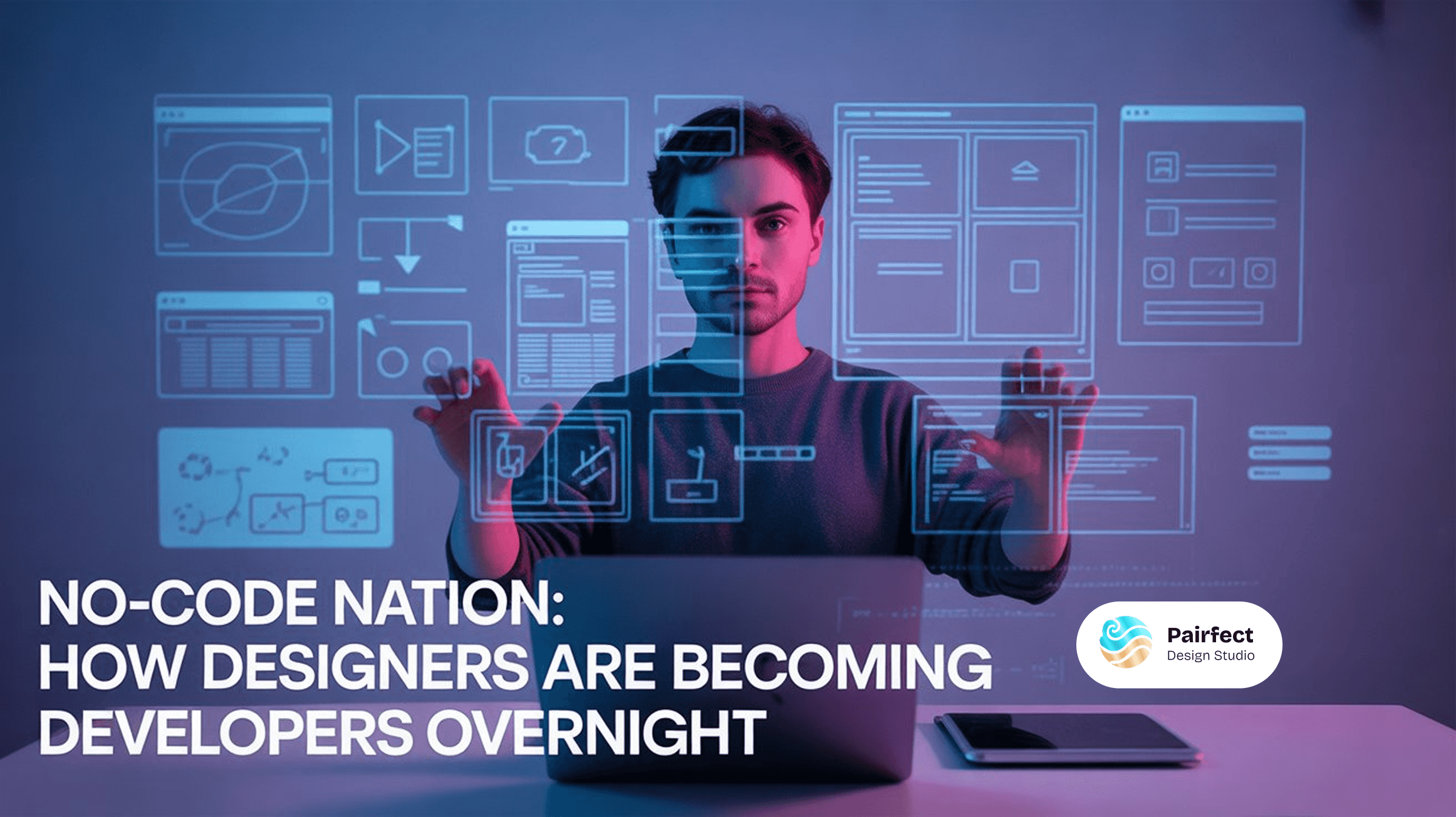
No-code platforms are turning designers into developers by giving them the power to build apps, automate tasks, and launch products without coding.
From the last decade to the present, the digital ecosystem has transformed very quickly; however, No-Code Platforms, the rise of No-Code Development, and the fast-growing No-Code Ecosystem have changed the developer-to-creative balance more than any other technology shift. What once required a full team of developers, specialists, large budgets, and long timelines can now be created by a single designer with inspiration, internet access, and powerful No-Code Tools. We are rapidly becoming a No-Code Movement–driven world where many discover that they can create digital products differently. As Designers Becoming Developers becomes increasingly common, the entire landscape of Digital Product Development is being rewritten.
Instead of only being visual or UX experts, designers are now responsible for tasks historically performed by engineers. The ability for designers to develop and release their own No-Code Applications, publish dashboards, automate workflows, and deploy full end-to-end No-Code Software solutions has shifted from impossible to achievable in days. No-Code Development is the movement democratizing Digital Product Development, and as a result, designers are not just assisting in product creation they are becoming No-Code Platforms power users and true digital developers.
The progress of No-Code Tools has advanced far beyond the early days of drag-and-drop website builders. Originally, the No-Code Ecosystem was a category describing simple site builders, forms, and design tools. Recently, it evolved into a full stack used for enterprise-grade systems, large No-Code Software deployments, and even government-level No-Code Applications. Today, No-Code Platforms enable startups, enterprises, and digital creators to build, integrate, automate, and deploy complex products visually.
Modern No-Code Platforms allow creators to design with drag-and-drop components, create logic, integrate with CRM systems, automate Marketing workflows, plug into communication channels, and deploy across environments. These tools show how the No-Code Movement is blending creativity with functionality, accelerating Digital Product Development like never before.
Examples of No-Code Tools dominating the industry include Webflow, Bubble, Framer, Airtable, Zapier, Make, Wix Studio, AppSheet, and Glide. These platforms form the backbone of today’s No-Code Ecosystem, allowing designers to build enterprise-class No-Code Applications without writing traditional code.
As these tools matured, they started connecting the dots between design and engineering. Designers who once built static prototypes now create production-ready No-Code Software experiences. The time from concept to deployment has drastically reduced, and designers are now leading the charge in No-Code Development.
Designers Are Transitioning to Developers
1. Knowledge of User Experience
Developers create functionality through code, while designers build intuitive ways to use functionality. With No-Code Platforms, designers blend both worlds. They continue applying design-thinking while building complete No-Code Applications. Designers who understand customer experience can now implement it directly, test instantly, and iterate faster all within the No-Code Ecosystem.
2. Thinking Visually, Not Traditionally
Most No-Code Tools rely on visual builders, drag-and-drop components, logic trees, and conditional statements. This mirrors exactly how designers already think. Instead of learning programming languages, designers use No-Code Platforms to visually map functionality. This lowers the learning curve dramatically and accelerates No-Code Development for non-technical creators.
3. Speed as a Competitive Advantage
Modern clients expect rapid delivery. Launching an MVP in days is now normal. No-Code Applications give designers an edge:
Fast prototype launches
No dependency on dev sprints
Lower cost Digital Product Development
Instant iteration based on feedback
Speed matters, and No-Code Platforms empower creators to move at industry-level pace.
4. New Patterns of Collaboration
Traditionally, designers and developers rarely overlapped deeply. Now, the No-Code Movement has eliminated that barrier. Designers build full functionality through No-Code Tools and hand projects to developers only for:
Custom integrations
Advanced scalability
Security
Performance optimization
This shift streamlines workflows and enhances No-Code Development across teams.
Examples of What Designers Now Build with No-Code
A) Websites & Web Apps
Using Webflow or Framer, designers build responsive, dynamic No-Code Software and powerful No-Code Applications without backend coding.
B) Mobile Apps
AppSheet and Glide enable designers to build mobile apps directly from spreadsheets or databases through No-Code Platforms.
C) Automations & Workflows
Zapier and Make provide deep automation capabilities syncing data, triggering notifications, and connecting CRMs all part of the broader No-Code Ecosystem.
D) Internal Dashboards & Tools
Airtable, Notion, and other No-Code Platforms allow companies to centralize operations, internal systems, and dashboards using visual No-Code Tools.
E) MVPs & Startup Applications
Booking systems, marketplaces, SaaS dashboards, and community apps can be made quickly using No-Code Development workflows.
Designers Are Becoming Strategic Builders
Designers embracing No-Code Applications also learn how data connects, how flows operate, how logic works, and how backend architecture is organized. This new systems-thinking ability makes Designers Becoming Developers a natural evolution.
With these skills, designers become independent builders, capable of:
Connecting APIs through No-Code Tools
Creating dynamic components
Implementing conditional logic
Testing responsive layouts
Managing Digital Product Development end-to-end
This new independence increases their value inside organizations. Companies now want individuals who can design, build, launch, and maintain No-Code Software systems.
Many designers are also entering entrepreneurship launching agencies, SaaS products, tools, marketplaces, and other No-Code Applications through No-Code Platforms.
No-Code vs Developers: The Truth
A common myth claims the No-Code Movement will replace developers. The reality is that No-Code vs Developers is not a battle, it's a partnership.
Developers are still essential for:
Large-scale infrastructures
Complex system architectures
Performance optimization
Advanced integrations
High-security environments
No-Code Platforms accelerate early development, while traditional engineering supports long-term scalability.
Everyone Can Build Now
No-Code Development democratizes creation just like smartphones democratized content. Teachers, marketers, artists, and founders can now develop apps using No-Code Tools.
Companies benefit from bottom-up innovation because anyone with an idea can prototype a solution within the No-Code Ecosystem.
This has led to:
More innovation
Faster experimentation
More micro-products
A rise in Designers Becoming Developers
Conclusion: A New Hybrid Creator Is Born
The world is shifting into a No-Code Platforms era where creativity meets functionality, empowering a new generation of hybrid creators. Designers are now building No-Code Software, launching businesses, automating processes, and transforming entire industries without writing a single line of code. The future belongs to creators who can merge imagination with technical execution through No-Code Development and this movement is accelerating faster than ever.
Today, thanks to the expanding No-Code Movement, designers are truly becoming developers almost overnight. And as this evolution continues, Pairfect Design Studio remains committed to championing these innovations, empowering creators to push boundaries and turn ideas into reality with unmatched speed and precision.

Tell Us What to Build
Share what you want to launch. product, website, or MVP, and we’ll respond with the right low‑code approach, estimate, and roadmap to go live.
Let’s Connect & Create Something Beautiful!
Reach out to us today and let’s discuss your needs.
Let’s Connect & Create Something Beautiful!
Reach out to us today and let’s discuss your needs.
Let’s Connect & Create Something Beautiful!
Reach out to us today and let’s discuss your needs.
No-code platforms are turning designers into developers by giving them the power to build apps, automate tasks, and launch products without coding.
Vignesh
UX UI Designer & Content Writer
Dec 11, 2025
No-Code Nation: How Designers Are Becoming Developers Overnight?
From the last decade to the present, the digital ecosystem has transformed very quickly; however, No-Code Platforms, the rise of No-Code Development, and the fast-growing No-Code Ecosystem have changed the developer-to-creative balance more than any other technology shift. What once required a full team of developers, specialists, large budgets, and long timelines can now be created by a single designer with inspiration, internet access, and powerful No-Code Tools. We are rapidly becoming a No-Code Movement–driven world where many discover that they can create digital products differently. As Designers Becoming Developers becomes increasingly common, the entire landscape of Digital Product Development is being rewritten.
Instead of only being visual or UX experts, designers are now responsible for tasks historically performed by engineers. The ability for designers to develop and release their own No-Code Applications, publish dashboards, automate workflows, and deploy full end-to-end No-Code Software solutions has shifted from impossible to achievable in days. No-Code Development is the movement democratizing Digital Product Development, and as a result, designers are not just assisting in product creation they are becoming No-Code Platforms power users and true digital developers.
The progress of No-Code Tools has advanced far beyond the early days of drag-and-drop website builders. Originally, the No-Code Ecosystem was a category describing simple site builders, forms, and design tools. Recently, it evolved into a full stack used for enterprise-grade systems, large No-Code Software deployments, and even government-level No-Code Applications. Today, No-Code Platforms enable startups, enterprises, and digital creators to build, integrate, automate, and deploy complex products visually.
Modern No-Code Platforms allow creators to design with drag-and-drop components, create logic, integrate with CRM systems, automate Marketing workflows, plug into communication channels, and deploy across environments. These tools show how the No-Code Movement is blending creativity with functionality, accelerating Digital Product Development like never before.
Examples of No-Code Tools dominating the industry include Webflow, Bubble, Framer, Airtable, Zapier, Make, Wix Studio, AppSheet, and Glide. These platforms form the backbone of today’s No-Code Ecosystem, allowing designers to build enterprise-class No-Code Applications without writing traditional code.
As these tools matured, they started connecting the dots between design and engineering. Designers who once built static prototypes now create production-ready No-Code Software experiences. The time from concept to deployment has drastically reduced, and designers are now leading the charge in No-Code Development.
Designers Are Transitioning to Developers
1. Knowledge of User Experience
Developers create functionality through code, while designers build intuitive ways to use functionality. With No-Code Platforms, designers blend both worlds. They continue applying design-thinking while building complete No-Code Applications. Designers who understand customer experience can now implement it directly, test instantly, and iterate faster all within the No-Code Ecosystem.
2. Thinking Visually, Not Traditionally
Most No-Code Tools rely on visual builders, drag-and-drop components, logic trees, and conditional statements. This mirrors exactly how designers already think. Instead of learning programming languages, designers use No-Code Platforms to visually map functionality. This lowers the learning curve dramatically and accelerates No-Code Development for non-technical creators.
3. Speed as a Competitive Advantage
Modern clients expect rapid delivery. Launching an MVP in days is now normal. No-Code Applications give designers an edge:
Fast prototype launches
No dependency on dev sprints
Lower cost Digital Product Development
Instant iteration based on feedback
Speed matters, and No-Code Platforms empower creators to move at industry-level pace.
4. New Patterns of Collaboration
Traditionally, designers and developers rarely overlapped deeply. Now, the No-Code Movement has eliminated that barrier. Designers build full functionality through No-Code Tools and hand projects to developers only for:
Custom integrations
Advanced scalability
Security
Performance optimization
This shift streamlines workflows and enhances No-Code Development across teams.
Examples of What Designers Now Build with No-Code
A) Websites & Web Apps
Using Webflow or Framer, designers build responsive, dynamic No-Code Software and powerful No-Code Applications without backend coding.
B) Mobile Apps
AppSheet and Glide enable designers to build mobile apps directly from spreadsheets or databases through No-Code Platforms.
C) Automations & Workflows
Zapier and Make provide deep automation capabilities syncing data, triggering notifications, and connecting CRMs all part of the broader No-Code Ecosystem.
D) Internal Dashboards & Tools
Airtable, Notion, and other No-Code Platforms allow companies to centralize operations, internal systems, and dashboards using visual No-Code Tools.
E) MVPs & Startup Applications
Booking systems, marketplaces, SaaS dashboards, and community apps can be made quickly using No-Code Development workflows.
Designers Are Becoming Strategic Builders
Designers embracing No-Code Applications also learn how data connects, how flows operate, how logic works, and how backend architecture is organized. This new systems-thinking ability makes Designers Becoming Developers a natural evolution.
With these skills, designers become independent builders, capable of:
Connecting APIs through No-Code Tools
Creating dynamic components
Implementing conditional logic
Testing responsive layouts
Managing Digital Product Development end-to-end
This new independence increases their value inside organizations. Companies now want individuals who can design, build, launch, and maintain No-Code Software systems.
Many designers are also entering entrepreneurship launching agencies, SaaS products, tools, marketplaces, and other No-Code Applications through No-Code Platforms.
No-Code vs Developers: The Truth
A common myth claims the No-Code Movement will replace developers. The reality is that No-Code vs Developers is not a battle, it's a partnership.
Developers are still essential for:
Large-scale infrastructures
Complex system architectures
Performance optimization
Advanced integrations
High-security environments
No-Code Platforms accelerate early development, while traditional engineering supports long-term scalability.
Everyone Can Build Now
No-Code Development democratizes creation just like smartphones democratized content. Teachers, marketers, artists, and founders can now develop apps using No-Code Tools.
Companies benefit from bottom-up innovation because anyone with an idea can prototype a solution within the No-Code Ecosystem.
This has led to:
More innovation
Faster experimentation
More micro-products
A rise in Designers Becoming Developers
Conclusion: A New Hybrid Creator Is Born
The world is shifting into a No-Code Platforms era where creativity meets functionality, empowering a new generation of hybrid creators. Designers are now building No-Code Software, launching businesses, automating processes, and transforming entire industries without writing a single line of code. The future belongs to creators who can merge imagination with technical execution through No-Code Development and this movement is accelerating faster than ever.
Today, thanks to the expanding No-Code Movement, designers are truly becoming developers almost overnight. And as this evolution continues, Pairfect Design Studio remains committed to championing these innovations, empowering creators to push boundaries and turn ideas into reality with unmatched speed and precision.
Tell Us What to Build
Share what you want to launch. product, website, or MVP, and we’ll respond with the right low‑code approach, estimate, and roadmap to go live.